What Is the Hardest Chinese Character to Write?
August 2026
The most complex Chinese characters ever written: a 57-stroke noodle character, 48-stroke dragons and a 36-stroke dictionary record — and why you will never need any of them.
Every so often a screenshot of a towering, impossibly dense Chinese character goes viral: "this is the hardest character in Chinese!" The real answer is more fun than the screenshot — and the takeaway is the opposite of what you would expect. There is no single "hardest character", but there are a few famous records worth knowing.
The legend: the 57-stroke noodle character (biáng)
If you ask people for "the most complex Chinese character", most will say biáng — the character for biangbiang noodles, a famous hand-pulled noodle dish from Shaanxi province. The character is a folk invention, not found in standard dictionaries, with around 57 strokes. It stacks an astonishing list of components: 穴 (cave), 言 (speech), 幺幺 (two threads), 馬 (horse), 長長 (long, twice), 心 (heart) and more. It is so unwieldy that locals memorize a folk rhyme to write it — "one dot flies to the sky, the Yellow River bends on both sides…".
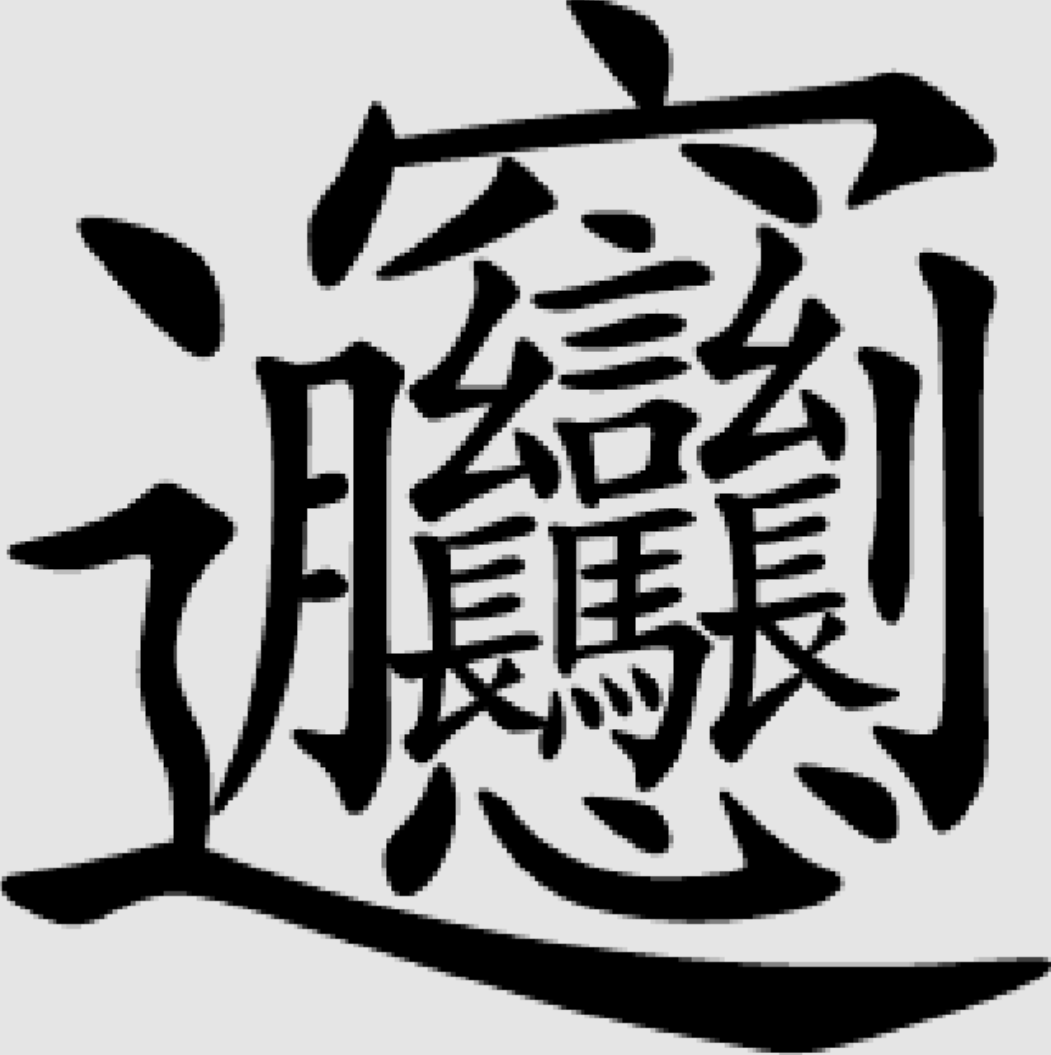
One practical warning: biáng is so new that it is missing from many fonts. On some phones and computers it will not display at all — you will just see an empty box. That alone tells you how far outside normal Chinese it lives.
The dictionary record: 齉 (36 strokes)
The most stroke-heavy character you will actually find in a standard dictionary: 36 strokes. It means "stuffy nose" — and appears in almost nothing else. A perfect record: technically real, practically useless.
Dragons and thunder: when characters stack
Most record-breakers are not new ideas — they are the same idea repeated until the character overflows its square. Chinese loves this trick:
- 龘 dá — 48 strokes: three 龍 (dragon) stacked. Means "the appearance of a dragon in flight".
- 龖 dá — 32 strokes: two 龍. The same idea, one dragon less.
- 靐 bìng — 39 strokes: three 雷 (thunder). The sound of thunder.
- 䨻 bèng — 52 strokes: four 雷. Beats 龘 at 52 strokes — four thunderclouds in a trench coat.
See the pattern? Once you know how characters are assembled, even the "hardest" ones stop being mysterious — they are just the same component stacked two, three or four times.
Unicode keeps one-upping itself
The extended Unicode standard contains even wilder specimens — including a 64-stroke character made of four 龍 (𪚥). These are display pieces: almost no one can write them from memory, and no font is guaranteed to show them. They exist to prove a point, not to be used.
The hard ones you actually meet
Here is the honest answer: you will almost certainly never write 齉 or 龘. Daily literacy in Chinese needs roughly 2,500 to 3,000 characters, and the characters that feel hard in real life are not stacked dragons — they are dense, everyday characters like these:
赢 squeezes five components into one cell; 舞 and 鼻 are 14 strokes of balance. These are the characters you will write every week for the rest of your Chinese life.
The takeaway
Complexity is not the point. The most complex characters are novelties — three dragons in a trench coat. Master the few thousand useful ones, and leave the record-breakers on the poster where they belong.
Skip the dragons and practice the ones that matter — generate a sheet with 赢舞鼻懂谢读 and trace the hardest characters you will actually use.
Generate a worksheet